
Observation
Seeing Trees Differently
Professional tree care starts with learning to see trees as living structures rather than static objects. An arborist looks beyond height and appearance to understand how a tree carries load, responds to stress, and fits into its surroundings.
What arborists look for
- Load paths
- Structural defects
- Root stability
- Species characteristics
- Wind exposure
- Decay progression
- Wildlife habitat
- Management opportunities
Risk context
Tree Risk Assessment
Tree risk is not just a feature of the tree. Risk is a relationship between the tree and its surroundings. A defect in a remote forest may matter very little, while a similar defect over a driveway, home, campsite, or play area may deserve closer attention.
Risk assessment considers
- The likelihood of failure
- The size of the part that may fail
- Potential targets
- Consequences
Failure modes
How Trees Fail
Trees can fail in different ways. Understanding the likely mode of failure helps an arborist decide whether pruning, monitoring, access control, habitat retention, or removal is the most reasonable option.
- Stem failure: breakage within the trunk.
- Branch failure: failure of individual limbs.
- Root plate failure: the entire tree uproots.
- Included bark failure: weak branch unions separate.
- Decay-related failure: structural wood loses strength over time.
Safe planning
The Working At Height Hierarchy
Professional tree work is planned from the ground up. The safest exposure is the one that can be avoided, so work-at-height decisions follow a hierarchy before a climber enters the tree.
- Step 1 – Avoid Working At Height
- Step 2 – Use Machinery
- Step 3 – Use A Crane
- Step 4 – Climbing
Access
Entering The Canopy
Climbing often begins with a throwline: a light line attached to a weighted throw bag that is placed over a suitable limb. That line can be used to install a climbing rope once the arborist has assessed the anchor point, surrounding structure, and possible defects. Ladders may help with access, but they are access tools rather than work platforms for cutting, rigging, or moving through a canopy.
Tree preservation
Why Arborists Don't Use Spikes On Retained Trees
Climbing spikes are generally reserved for removals. On a tree that is being retained, spikes puncture bark and living tissues, creating unnecessary wounds that can damage the cambium and provide entry points for decay organisms. If the goal is to keep the tree, the climbing system should avoid that avoidable injury.
Climbing systems
Double Rope Technique
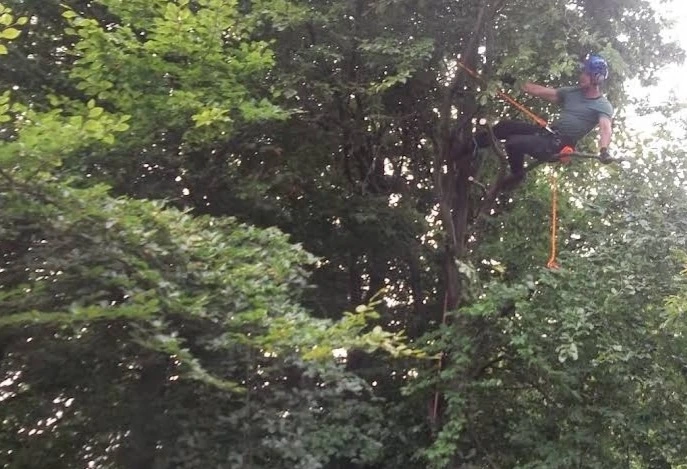
Double Rope Technique, often shortened to DdRT, uses a rope doubled over an anchor point so the climber can ascend, descend, and move through the canopy in a controlled way. The system allows careful positioning, controlled movement, and repeated adjustment while the arborist works around branches, defects, and changing rope angles.
The View From The Top
From the top of a large tree, the property looks different. Roofs, driveways, fuel breaks, neighbouring trees, slope, wind exposure, and landing zones all become part of the same picture. That perspective helps explain why professional tree work is never just about one branch or one cut. It is about the whole site.
Climber judgement
Anchor Points & Trust
A climbing anchor is selected because it can reasonably support the forces expected from the work. That judgement depends on experience, inspection, and an understanding of how load moves through wood.
Anchor selection considers
- Species
- Branch structure
- Defects
- Load paths
- Wood condition
Controlled removal
Rigging: Controlling The Impossible
Rigging is the process of controlling large pieces of wood when they cannot be safely dropped. Ropes, friction devices, blocks, redirects, lowering points, and communication all work together to move limbs and stems in a predictable way. The goal is not to make heavy wood light; it is to control how it moves.
Forces
Why Weight Is Only Part Of The Story
A piece of wood does not only apply its static weight to a rigging system. If it falls before the rope catches it, the system can experience shock loading. The force depends on how far the piece falls, how the rope stretches, and how quickly the piece is brought to a stop.
Shock loading depends on
- Piece weight
- Fall distance
- Rope stretch
- System geometry
- Deceleration distance
High-force work
Negative Rigging
Negative rigging occurs when the rigging point is below the section being removed. The piece falls past the rigging point before the rope arrests it, creating high forces in the rope, anchor, stem, and lowering system. This is why negative rigging requires careful planning, conservative piece sizing, and a clear understanding of system limits.
Tree response
CODIT: How Trees Respond To Injury
Trees do not heal the way people do. Instead, they compartmentalise. CODIT stands for Compartmentalisation Of Decay In Trees, a model that describes how trees limit the spread of decay by forming chemical and physical boundaries around injured or infected wood.
Good pruning and careful work respect those boundaries. Poor cuts, repeated wounds, and unnecessary damage can make compartmentalisation harder and reduce the long-term strength of the tree.
Below ground
Root Plate Mechanics
The visible trunk is only part of the structure. Root stability depends on the root plate, the surrounding soil, and the way roots distribute load into the ground.
Root stability is affected by
- Soil type
- Root distribution
- Moisture content
- Decay
- Excavation
- Frost heave
Wind and soil
Wind Loading & Soil Shear Strength
Wind pushes on the crown and turns the tree into a lever. That load interacts with wood strength, root strength, and soil strength. If the soil cannot resist the forces moving through the root plate, the tree may uproot even when the stem itself remains intact. Saturated soils, thawing ground, frost heave, excavation, and root decay can all change how much load the system can resist.
Understanding Trees
Trees are complex living structures. They grow, adapt, seal off injury, shed parts, add wood where they need strength, and respond to their environment over decades. Arboriculture is the practice of reading those responses and making careful decisions that balance safety, tree value, habitat, access, and long-term site goals.
Pruning systems
PRUNING: WORKING WITH THE TREE, NOT AGAINST IT
Pruning is not simply cutting branches. Good pruning works with the tree's biology and structure. It removes or reduces specific parts for a clear reason while protecting branch collars, maintaining natural form, and avoiding unnecessary wounds.
Crown Cleaning
Crown cleaning removes material that is dead, damaged, diseased, or likely to fail from the canopy.
- Dead branches
- Broken branches
- Diseased branches
- Hanging branches
- Crossing branches
Crown Lifting
Crown lifting selectively removes lower branches to create practical clearance while preserving the tree's overall form.
- Improve access
- Increase visibility
- Provide clearance over roads
- Reduce wildfire ladder fuels
- Improve views
Crown Thinning
Crown thinning selectively removes branches within the canopy to improve structure without stripping the tree or creating excessive gaps.
- Reduce end weight
- Improve light penetration
- Reduce sail effect
- Improve canopy structure
Crown Reduction
Crown reduction decreases the size or spread of a tree or limb by pruning back to suitable laterals, often to reduce load while retaining the tree.
- Reduce loading
- Improve clearance
- Retain habitat
- Extend retention potential
Crown Restoration
Crown restoration guides damaged, topped, storm-broken, or previously mismanaged trees back toward a more natural and stable structure over time. It may take several pruning cycles and should be based on what the tree can realistically support.
Adaptive growth
REACTION WOOD: HOW TREES FIGHT GRAVITY
Reaction wood is one of the ways trees respond to lean, load, and movement. Instead of staying perfectly symmetrical, a tree adds specialized wood where it needs to push, pull, or reinforce its structure.
Compression Wood
In conifers, reaction wood is usually compression wood. It forms on the lower side of leaning stems or branches and helps push the structure upward. It can be dense, resinous, and different from normal wood.
Tension Wood
In many deciduous trees, reaction wood is usually tension wood. It forms on the upper side of leaning stems or branches and helps pull the structure back toward a more favourable position.
Reading The Story
Reaction wood, sweep, lean, and asymmetry can tell the story of what a tree has experienced over time.
- Wind exposure
- Snow loading
- Competition for light
- Ground movement
Structural engineering
BIOMECHANICS: THE ENGINEERING OF TREES
Tree biomechanics is the study of how trees carry forces. A tree is not a rigid pole; it is a flexible living structure that distributes load through branches, stem, roots, and soil.
Load Paths
Loads move from the outer crown through connected structure and into the ground.
- Branches
- Into the stem
- Into the root system
- Into the soil
Why Big Trees Usually Don't Fall Over
Large trees usually remain standing because they have adapted to their site over decades. Each year they add wood in response to wind, snow, lean, competition, and exposure. Their strength is not accidental; it is the result of long-term growth responding to repeated loading.
The Cost Of Interference
Construction, excavation, soil compaction, root cutting, grade changes, and improper pruning can interrupt the systems a tree has built over time. The results may not appear immediately. Delayed failures can occur years after roots are damaged, soil is changed, or a crown is altered in a way that increases stress.
Decision making
HOW ARBORISTS ESTIMATE RISK
Risk assessment helps turn observations into practical decisions. It does not remove uncertainty, but it gives the discussion structure.
Understanding Risk
Probability of Failure × Consequences of Failure
A tree part with a low likelihood of failure may still matter if the consequences are severe. A likely failure may be low risk if there is no target. Both parts of the equation matter.
Qualitative Tree Risk Assessment
Qualitative assessment uses structured professional judgement to describe risk in words rather than exact numbers.
- Species characteristics
- Defects
- Site conditions
- Targets
- Occupancy
- History
Quantified Tree Risk Assessment
Quantified Tree Risk Assessment, or QTRA, uses a numerical framework to compare likelihood, target occupancy, and consequences. It can help communicate risk consistently, especially where decisions require documentation or comparison between options.
The Limits Of Numbers
Numbers can support decisions, but they do not replace professional judgement. Trees are living organisms, and site conditions change.
- Experience
- Biology
- Engineering
- Site knowledge
- Structured methodology
- Professional judgement
Property awareness
A HOMEOWNER'S GUIDE TO TREE RISK ASSESSMENT
Homeowners do not need to diagnose every defect. The goal is to notice meaningful change, understand what might be at risk, and know when to ask for help.
Signs Worth Investigating
These signs do not automatically mean a tree must be removed, but they are worth a closer look.
- Recent Leaning
- Soil Lifting Around The Base
- Large Dead Branches
- Fungal Fruiting Bodies
- Major Cavities
- Cracks In The Stem
- Repeated Branch Failures
- Sudden Crown Decline
- Construction Damage
- Excavation Near Roots
Signs That Are Often Less Serious
Some tree features look concerning but may be normal when they are stable, minor, or long-standing.
- A slight lean that has existed for decades.
- Minor deadwood.
- Seasonal needle shedding.
- Small wounds.
- Natural asymmetry.
The Most Important Question
“What would it hit if it failed?”
This question connects tree condition to real-world consequences. It helps separate low-priority observations from issues that may affect homes, vehicles, access routes, people, or neighbouring property.
When To Seek Professional Advice
If a tree starts attracting your attention, has changed recently, or shows signs that make you uneasy, it is reasonable to ask for a professional assessment. A good assessment can help you understand the tree, the site, and the range of options before deciding whether to prune, monitor, retain, create habitat, restrict access, or remove the tree.