
White spruce
Picea glauca
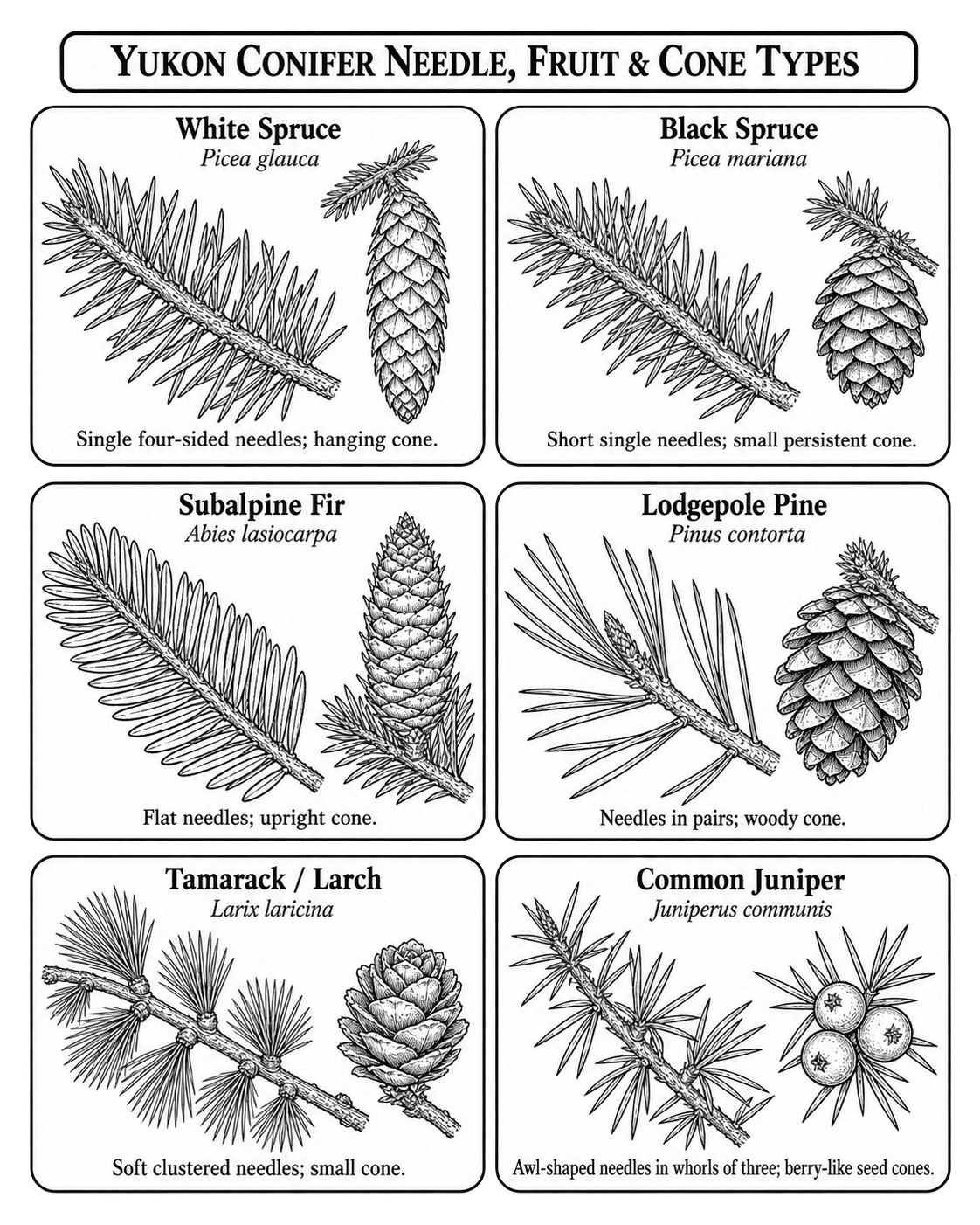
Single, stiff, four-sided needles; elongated cones hang from the branch.
Illustrated field guide
Learn to recognise common Yukon trees by reading the details they carry—from a single needle or bud to bark, cones and the shape of the whole tree.
Before you begin
No single characteristic tells the whole story. Choose a healthy, typical sample where possible, and use several traits together before settling on an identification.
Needles or broad leaves divide the search quickly. Then look at how needles attach or at the leaf shape, edge and stalk.
Compare foliage with buds, twigs, cones, bark and overall growth form. One feature can be misleading.
Moisture, elevation, drainage and disturbance can support an identification—but habitat should confirm, not replace, visible traits.
Young and mature bark can look different, shoots can carry unusual leaves, and weathered cones may change colour and shape.
Needles & cones
Start by looking at how the needles meet the twig. Are they single, paired or clustered? Then find a cone if one is available.
Picea glauca
Single, stiff, four-sided needles; elongated cones hang from the branch.
Picea mariana
Short, single needles and small cones that can persist on the tree.
Abies lasiocarpa
Soft, flat needles; cones stand upright rather than hanging.
Pinus contorta
Long needles held in pairs and a firm, woody cone.
Larix laricina
Soft needles in dense clusters; unlike most conifers, the needles are shed in autumn.
Juniperus communis
Sharp needles in whorls of three with round, berry-like seed cones.
Leaves, buds & bark
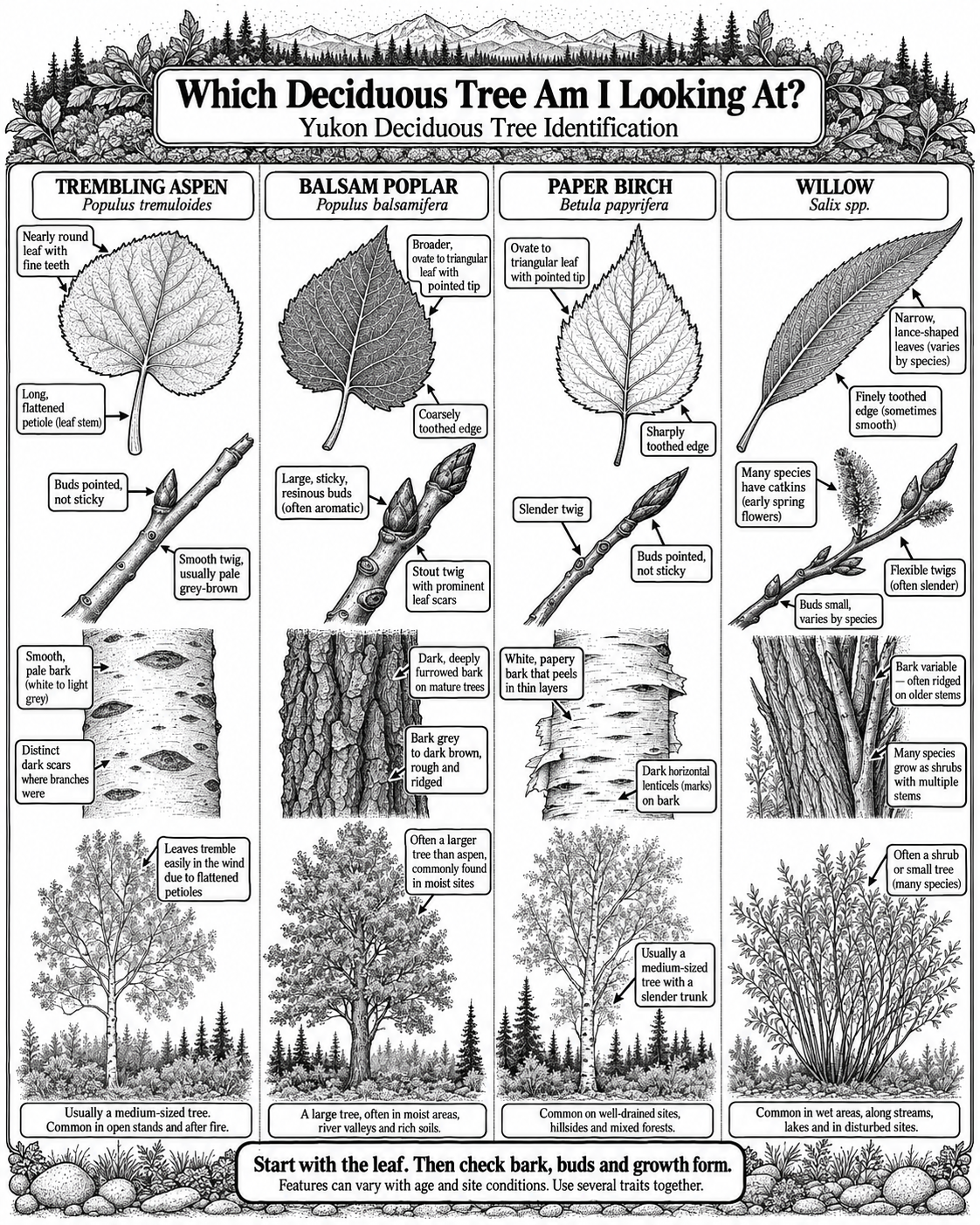
Start with leaf shape and the pattern along its edge. Follow with the buds and twig, then compare bark and growth form.
Populus tremuloides
Nearly round, finely toothed leaves on long, flattened stalks; smooth pale bark when young.
Populus balsamifera
Broad pointed leaves and large, sticky, often aromatic buds; mature bark becomes deeply furrowed.
Betula papyrifera
Sharply toothed leaves, slender twigs and white bark that peels in thin layers.
Salix species
Usually narrow leaves and flexible twigs; often multi-stemmed near water or disturbed ground.
A year-round skill
Winter identification relies more heavily on buds, twigs, bark and branching pattern. Look for sticky or pointed buds, the texture of a twig, old cones beneath the tree and whether the plant grows from one trunk or many stems.
Do not remove bark or break live branches to identify a tree. Fallen material and clear photographs usually provide enough detail for comparison.
Continue learning
Once you have a likely name, learn how Yukon conditions shape that species and how its characteristics influence management around a property.